
- calendar_today August 14, 2025
.
Electric vehicle sales in the US are faltering after more than a year of month-over-month growth, spurring new concerns about adoption rates and charging infrastructure. Consumers have already shunned the EVs from Genesis and Volvo, with both automakers planning to re-evaluate their offerings.
The political environment has also created headwinds, as the Biden administration has cut back subsidies and vehicle pollution rules. As a result, there are now fewer federal incentives for prospective EV buyers. But according to auto industry analysts, there may be another, less obvious challenge to EV adoption in America.
Consumer surveys have long shown charging anxiety to be a major EV sales killer. But a new study from Telemetry’s VP of Research Sam Abuelsamid homes in on a related, often overlooked factor: where we park at home.
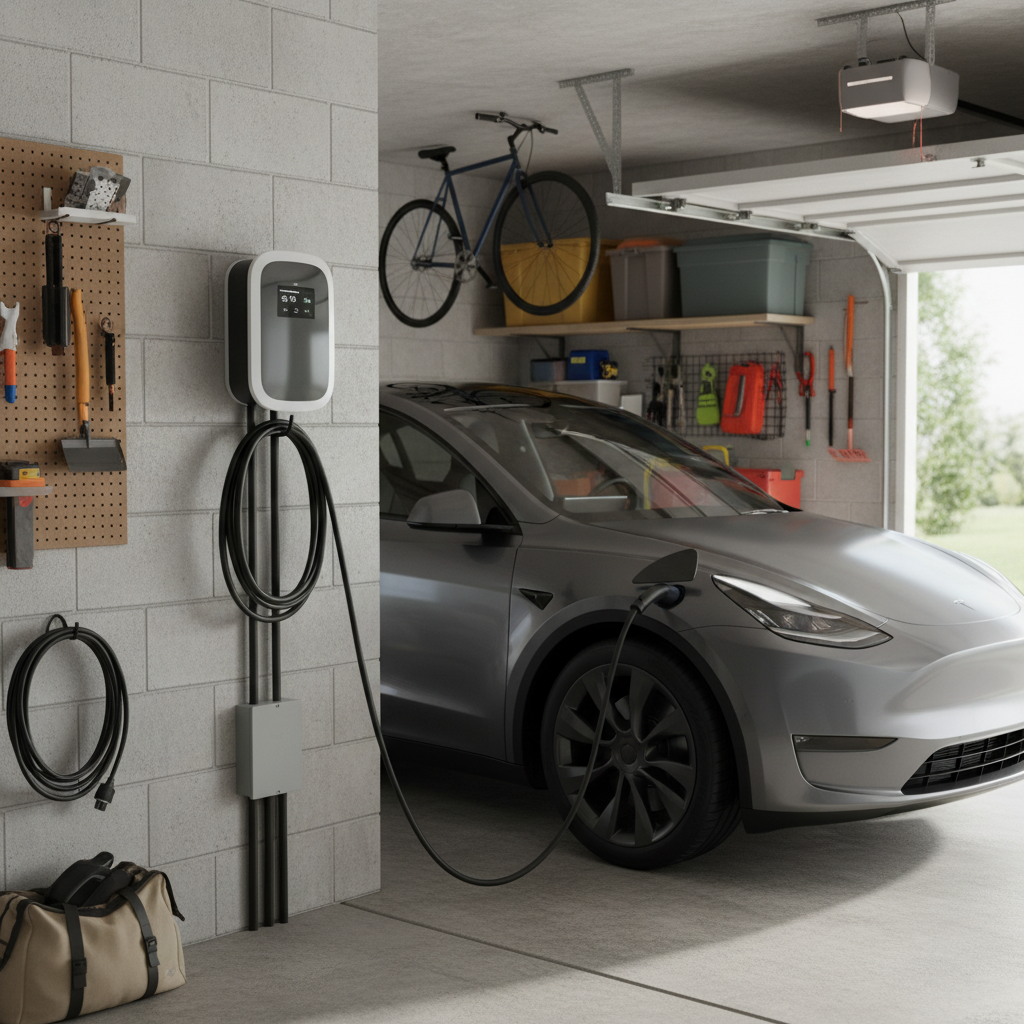
While public fast-charging networks make the news these days, most EV charging still happens at home. In fact, an estimated 80 percent of all EV charging is done with AC power, and a majority of these take place at a single-family home. This is supported by research from the National Renewable Energy Laboratory (NREL) that found 42 percent of homeowners already have a space where they park next to an outlet that can support level 2 charging (240-volts).
That figure could increase substantially, to 68 percent, if homeowners made more room in their garages and switched up their parking behavior. Abuelsamid explains that “90 percent of all houses could add a 240 V outlet near where cars are parked. Parking behavior, specifically whether homeowners use a private garage for parking or storage, will likely become a key factor in EV adoption.”
If more homes shifted their garage space from storage to vehicles, the total number of homes that can support EV charging would increase from 31 million to more than 50 million. Accounting for homes where wiring would be possible raises that number to more than 72 million. That’s above Telemetry’s high-end estimate of 57 million EVs in the US by 2035.
Home Charging: The Cost Hurdle
But potential doesn’t mean reality. The same NREL research found that nearly 34 million homes would need an expensive electrical upgrade to support a level 2 charger, which usually requires a 30-amp circuit or more. These upgrades can be as simple as adding new wiring and an outlet. But in many older or less modernized homes, it may require installing a new breaker box, which can run into the thousands.
This fact undercuts one of the traditional sales pitches for EVs: the total cost of ownership over the long term. Add in the cost of charging infrastructure, and the sticker shock can quickly meet or exceed the cost of a traditional gas car.
Multifamily Housing Remains a Hurdle
The situation gets even worse for the 23 percent of Americans living in multifamily housing, such as apartments, condos, and townhouses. In these residences, it’s not the homeowners but rather the landlords, property management companies, or co-op boards who have to approve charger installation. This rarely happens without significant pushback, making it difficult for individual EV owners to even try.
The financial barrier is also higher. Multi-unit buildings, especially those of co-ops, may require a full electrical panel upgrade before a pair of shared level 2 chargers can be installed, a multi-million-dollar project. Running wiring to distant parking spaces, as most of these properties have, is a further cost. And, unlike homeowners, residents in these buildings are rarely eligible for city or utility subsidies to help install charging.
Around 1 million current EV drivers live in multifamily housing, but only 11 percent park close enough to an outlet to be able to charge. In most states, utilities must ensure that X percent of the spaces in new multifamily developments are ready for EV charging. The national level is currently 20 percent, with several states now mandating 25 percent. However, Telemetry believes that only between 6.7 million and 11.4 million charging-capable spaces in multifamily dwellings by 2035. That total could still be short of the demand.
Public Charging Must Fill The Gap
Home charging won’t be enough. Telemetry estimates that between 11.7 million and 14.3 million EV drivers who own a house will also require public charging by 2035. Another 7.8 million to 8.1 million EV drivers living in multifamily residences will also rely on public charging.
To meet that demand, between 523,000 and 586,000 DC fast chargers will be needed, as will another 1.5 million to 1.6 million level 2 chargers across the country. However, adding this infrastructure has its own obstacles. Power companies are already at their limits, with new AI data centers vying for generation and distribution capacity, making the expansion of high-use charging sites all the more difficult.
Ambiguity in the Road Ahead
The initial excitement around EVs may not translate to straightforward success in the US. Garage clutter, high electrical upgrade costs, and multifamily housing can significantly slow adoption. Even with a major expansion in public charging infrastructure, demand is projected to exceed supply during the next decade.
For now, the one thing that’s clear is that the future of electric vehicles in America might depend as much on your garage as it does on the government or automakers.