
- calendar_today September 2, 2025
Apple seems to have discovered a new strategy to deal with President Donald Trump’s trade war: buttering up the president. On Wednesday, Trump said that Apple will not have to pay a forthcoming 100 percent tariff on semiconductors, which could have forced the company to hike iPhone prices in every market where they sell. As Reuters reported, the tariff exemption came after Apple said it would invest another $100 billion in the U.S. and gave Trump a statue.
Apple CEO Tim Cook said the statue was created by Corning, a company with a long history with Apple that makes specialty glass for the iPhone. It was cut into a large circle of glass with a big Apple logo in the middle. “It’s from Utah,” Cook said. “It’s made from a very special type of glass from a company called Corning that’s worked with Apple forever, but this is a very, very special glass.” The base of the statue was 24-karat gold and inscribed with Trump’s name, while Cook finished it off with a “Made in America” sign and his own signature.
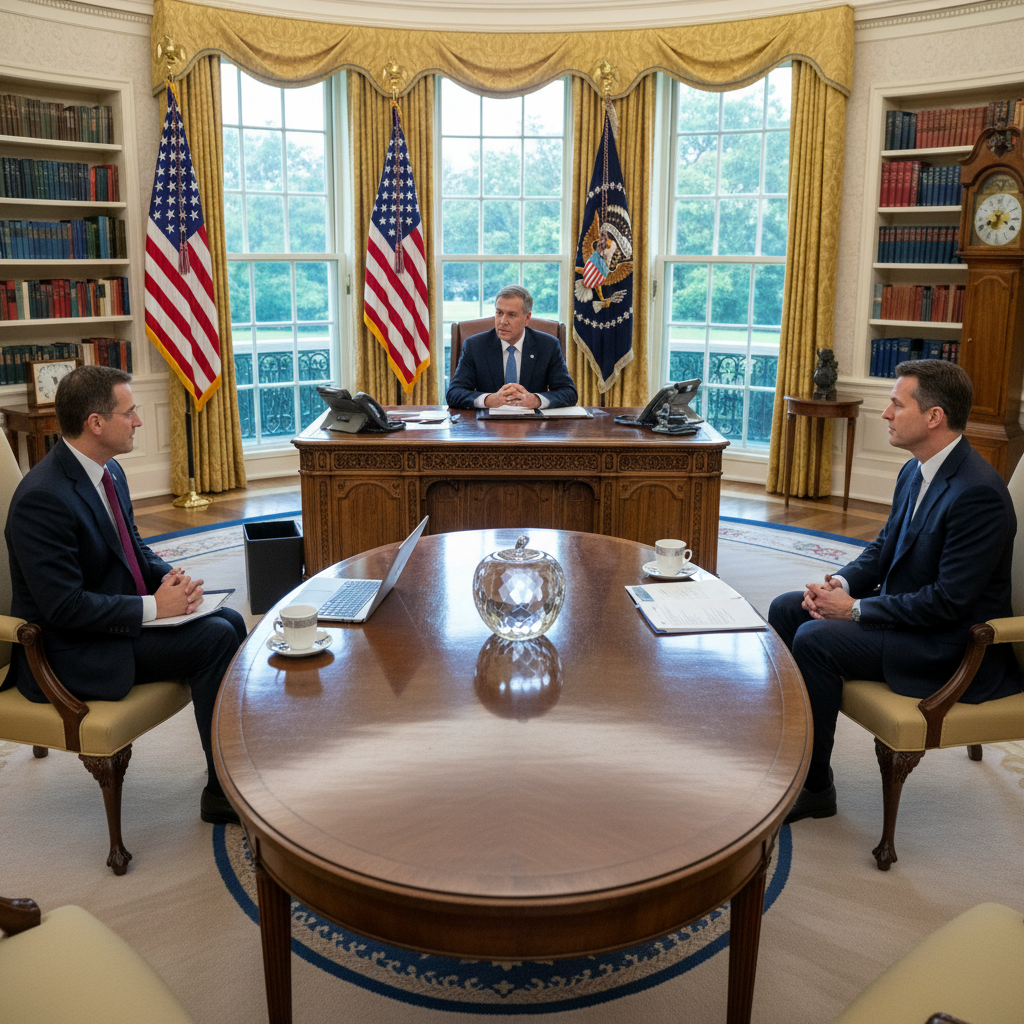
Trump, who has repeatedly told companies to make more products in the U.S., seemed pleased by the gift. He said in the Oval Office alongside Cook that Apple “will pay no charge” when the tariffs on semiconductors are implemented. For Apple, which Trump has publicly berated for months over where it builds its supply chain, the news is a major victory.
In particular, it represents a turning point in a difficult few months for Apple in the U.S. Trump had previously berated Apple for not shifting production of the iPhone to the U.S. instead of moving some production to India. In April, he went further and claimed his trade war would “end up with ‘Made in America’ iPhones.” By May, there was open hostility from the president, who tweeted that he had “a little problem with Tim Cook” as he traveled through the Middle East. In a reported conversation with Cook, Trump said, “We are treating you really good, we put up with all the plants you built in China for years. We are not interested in you building in India.”
Analysts have said for some time that shifting final assembly of the iPhone into the U.S. is neither a simple nor necessarily achievable process, but Trump’s administration pressed the message that it was. Commerce Secretary Howard Lutnick said that Apple was studying the “robotic arms” it could use to create a similar level of accuracy in U.S. factories to those in China.
Cook’s meeting with Trump on Wednesday suggests the president has dialed back some of his rhetoric. After once threatening a 25 percent tariff on Apple for not assembling iPhones in the U.S., Trump now frames the company’s actions as “a significant step toward the ultimate goal of ensuring that iPhones sold in America also are made in America.” In the short term, Trump has backed away from his demands.
Cook also said that “iPhone components like semiconductors, glass, and Face ID modules are already made in the U.S.A.,” but gave no indication of a timeline for shifting assembly of the iPhone to the U.S. and suggested it would remain outside the U.S. “for a while.”
This is a playbook Apple has followed with Trump for most of his first term. Cook courted Trump with promises to invest in the U.S. without meeting his most ambitious demands. In 2017, for instance, Trump boasted of Apple building three “big, beautiful” new plants in America, but one of the three actually built made face masks. A second Apple plant in Texas went to making MacBook Pro, not iPhones. In 2019, Trump said the same Texas plant could make iPhones. Apple gave it a MacBook Pro. Promises of $350 billion worth of investment have turned into commitments of $450 billion and more, but much of that is above and beyond what Apple was already planning to spend in the U.S.
Trump has warned that companies that fail to follow through on their investment plans will face retroactive tariffs. But Apple is continuing to invest in the U.S. as it always has, while keeping production of iPhones outside of the U.S., for the time being. The calculus on tariffs hasn’t changed, and Trump has chosen not to force the issue—at least for now.
Wall Street has a similarly positive take on Apple’s approach. Nancy Tengler, CEO and CIO of Laffer Tengler Investments, which owns Apple stock, told Reuters that Apple’s “strategy is a savvy solution to the president’s demand that Apple manufacture all iPhones in the U.S.”
Cook’s personal charm, plus a splash of gold and some carefully worded pledges, has once again given Apple time in the trade war with Trump. Trump has repeatedly couched the investment and production announcements as progress towards “Made in America” iPhones, but Apple has bought time on tariffs without committing to building its most complex assembly lines at home.