
- calendar_today August 15, 2025
Giger’s Forgotten Creature: The Alien Beauty of Sil
Last week, the entertainment world said goodbye to actor Michael Madsen, known for his work in Reservoir Dogs, Kill Bill, Donnie Brasco, and other iconic, often gritty film roles. But as many obituaries noted, the character actor’s long career also includes some less heralded and far stranger turns, one of which is as a black ops mercenary in the 1995 sci-fi horror film Species. Made at the height of Hollywood’s monster-movie boom and during a brief national paranoia about possible alien contact, the film was intended to draw from genre favorites such as The Thing, but also take some creative risks of its own. If you’re one of the many fans revisiting Species for the first time now that it’s celebrating its 30th anniversary, or if you’re discovering it for the first time at all, here are a few things you should know about its origins.
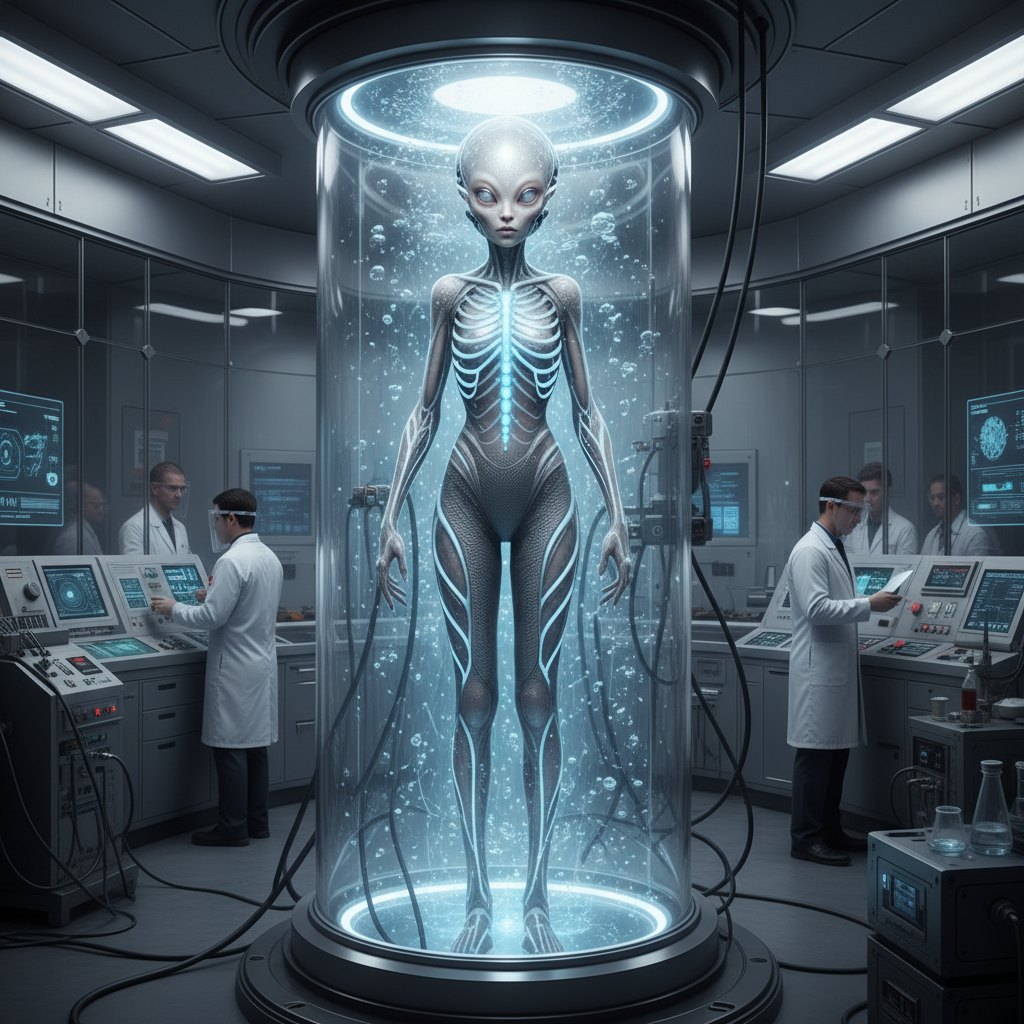
Species was co-written and directed by Roger Donaldson (No Way Out, The Bounty), and began with the classic “smart people get the government to do something we’ll later regret” set-up. In the film, two transmissions from outer space are received by the U.S. government, one detailing the process to develop a revolutionary fuel source, and the other providing a detailed blueprint for splicing alien and human DNA. As you might imagine, the government obliges. Under the watchful eye of Dr. Xavier Fitch (Ben Kingsley), a human-alien hybrid is born, called Sil. Played in her formative years by Michelle Williams, Sil was meant to be a controlled scientific experiment, but it quickly becomes clear that things didn’t go as planned.
Sil matures rapidly, arriving at the body of a 12-year-old girl in only three months, though with some unsettling behaviors and disturbing dreams. Fitch and his team find that Sil may not be as controllable as they originally thought, so he attempts to kill the experiment by releasing cyanide into her cell. Sil is not only unaffected but also escapes, setting the plot of the film in motion.
Fitch enlists a group of “specialists” to hunt down Sil, including Madsen’s Preston Lennox, a mercenary and no-nonsense operator; Dr. Laura Baker (Marg Helgenberger), a molecular biologist; Dr. Stephen Arden (Alfred Molina), an anthropologist; and Dan Smithson (Forest Whitaker), an empath with a rumbling voice who can “feel” Sil’s emotions. They head to Los Angeles, where Sil, now a young woman played by Natasha Henstridge, is focused on finding a mate and reproducing. Henstridge’s Sil is sexy, smart, and incredibly adaptive, and when she encounters the research team on her own Los Angeles turf, things go south for several hapless victims—train tramps, club-goers, and finally an unfortunate lover.
The Monster Inside
One of the most notable elements of Species was, of course, the creature design, which was handled by renowned surrealist artist H.R. Giger, best known for his work on the design of the xenomorph/alien from Alien. Giger was intrigued by making Sil “something new … an aesthetic warrior, also sensual and deadly.” He worked closely with Donaldson to shape the final film and was inspired by Sigourney Weaver’s character, Ellen Ripley, and some of her more dynamic fight scenes. In the end, Sil’s physical characteristics as a 12-year-old (hairless, with porous skin and visible ribbing) and as a young adult (pubic hair and long hair) were finalized, as was her final alien form. Giger described Sil’s fully developed state as a “glass body but with carbon inside,” and the design was considered finished. Giger also had detailed plans for other forms of the Sil alien, beginning with a human infant and working up through five stages of alien evolution, before ending in a true alien-human hybrid form at the climax. But budget and time restraints meant he was only able to design Sil’s cocoon and the full alien mother form in which Henstridge’s Sil ultimately transforms.
Though Species became a commercial hit, Giger was less than pleased with the finished film, which he later called a “very bad” and “disappointing” rehash of Alien, a film he’d worked on over a decade prior. He was particularly aghast at the similarities of the Sil’s iconic, “punching tongue” and the final act birth sequence, which he found too close to the “chestburster” scene in Alien. Giger was so put off that during filming, he stopped the director and crew to make sure that Sil was ultimately killed with a shot to the head rather than flame-throwers, which he pointedly noted would call Alien 3 and Terminator 2 to mind far too strongly.
Species was never an especially loved film. Many of the dialogue scenes and characterizations are clunky and underdeveloped. Dr. Fitch is no “mad scientist” and plays more of a procedural anchor than a real threat; Kingsley is unconvincing, and Whitaker’s empathetic character merely broods and makes observations that are painfully obvious to the rest of the audience. The themes of bioethics, alien contact, and maternal drive are touched on but not fully realized. But while the parts are uneven, the whole is an odd mix of accessible science fiction and erotic body horror. The screenwriter, Feldman, admitted he had initially written the opening sequences of government officials contemplating aliens contacting humans for a more serious science fiction take, but after encountering an article in Arthur C. Clarke’s that speculated faster-than-light travel was simply too improbable, Feldman posited the reverse: what if, instead of random space probes like the ones Clarke envisioned, Earth received blueprints for creating something alive? A virus? A biological weapon? After years of development, the film became a project that served dual purposes, both an eco-horror story and a creature feature.
Species isn’t a staple of the genre like Alien or Terminator, but it was a forerunner of sorts to later, similar films. It’s an occasionally bizarre mix of ’90s filmmaking: at times bloated and maudlin, and at others eminently watchable and fun. Between Henstridge’s alien performance, Madsen’s scenery-chewing, and Giger’s love-it-or-hate-it design, the film has a cult following that feels earned. Happy 30th, Species.