- calendar_today August 10, 2025
Eccentric and endangered: MJT damaged the July fire
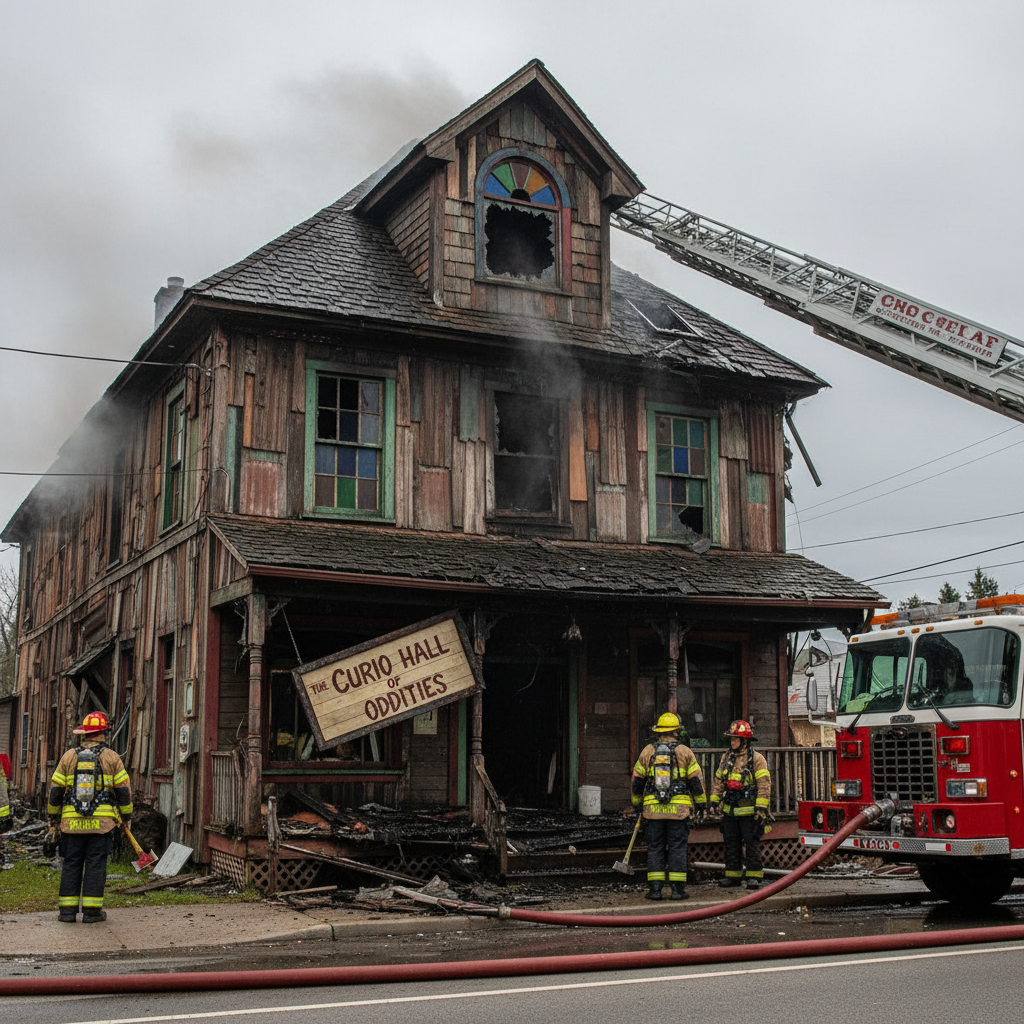
The Los Angeles Museum of Jurassic Technology is recovering after a fire caused significant damage to the museum’s building last month. The blaze, which started late on July 8, destroyed the museum’s gift shop and caused smoke damage to multiple exhibits throughout the facility. Revenue losses during the museum’s expected closure could amount to $75,000, though it may open again later this month.
A Local Anomaly
The Museum of Jurassic Technology (MJT) is a small, oddball museum in Los Angeles’ Culver City neighborhood that has been a favorite local secret for nearly three decades. Founded in 1988 by David Hildebrand Wilson and Diana Drake Wilson, the MJT has drawn visitors to its exhibits for its intentionally confusing and occasionally misleading curation. The museum purports to be “dedicated to the advancement of knowledge and the public appreciation of the Lower Jurassic,” but the connection is more in spirit than in fact. It’s a modern-day nod to the cabinets of curiosity—also known as wunderkammers—popular during the Renaissance, considered forerunners to the modern museum.
The MJT has long been known for its storytelling approach, mixing fact and fiction to question perception. While some exhibits use actual historical items, others mix history with fiction, and much of the museum often leaves visitors unsure about what’s true and what’s false. Among the museum’s many permanent exhibits are one that honors the research of Athanasius Kircher, a 17th-century real-life polymath and Jesuit priest with an insatiable curiosity; and another featuring the micro-miniature sculptures of 20th-century Armenian sculptor Hagop Sandaldjian that can fit inside the eye of a needle and are made out of a single human hair.
The quirk level also goes up a notch for other exhibits in the museum. One room is home to decomposing dice that belonged to magician Ricky Jay. Another room, called “The Garden of Eden on Wheels,” offers a visual record of the trailer parks of the Los Angeles area. There’s also stereographic radiographs of flowers, mosaics made out of butterfly wing scales viewed under a microscope, and an outlandish collection of letters written to the Mount Wilson Observatory by amateur astronomers between 1915 and 1935. Since 2005, the museum has also included a Russian tea room, an elaborate recreation of Tsar Nicholas II’s study in the Winter Palace in St. Petersburg.
The Fire and the Aftermath
Writer Lawrence Weschler, author of Mr. Wilson’s Cabinet of Wonder, a 1996 book that unpacks the origins of many of the museum’s exhibits, has published a first-hand account of the fire. He reports that the blaze was noticed by David Wilson, who lives in a house behind the museum. Wilson saw smoke coming from the museum and went out to investigate with two fire extinguishers in hand. “A ferocious column of flame leaped out at him,” Weschler later quoted Wilson as describing, “ascending in the air and climbing in a majestic rush up the corner wall that faces the street.”
The fire extinguishers that Wilson had with him, however, were not up to the task of putting the blaze out. Wilson’s daughter and son-in-law then appeared, with a larger fire extinguisher, and were able to beat the firefighters to the punch, shutting down the fire before they arrived. The fire department later told Wilson that it would have likely engulfed the entire building had the firefighters arrived a minute later.
While the fire was mostly contained to the gift shop at the front of the building, smoke had spread throughout the museum. Wilson likened the damage to the smoke as if “someone had poured a thin creamy brown liquid evenly over all the surfaces—the walls, the vitrines, the ceiling, the carpets, and eyepieces, everything.” Smoke damage poses unique issues, especially for a museum that takes such pride in its presentation. The museum’s staff and volunteers have since been scrubbing and repairing damaged surfaces, a time-consuming and slow process.
The museum has been focusing on publicity efforts to keep itself afloat while it deals with the damage, with Weschler publicly encouraging contributions to the museum’s general fund. He noted in his report on the blaze that the MJT is “one of the most truly sublime institutions in the country,” a one-of-a-kind venue “floating free of the usual definitions and expectations of science, art, and narrative.”
No reopening date has been set, but the general feeling is that the museum will return, as strange and sublime as ever, thanks to its devotion to a singular combination of satire, scholarship, and surrealism.