
- calendar_today August 17, 2025
Pedro Pascal and Cast Elevate a Mild Marvel Outing
Marvel’s The Fantastic Four: First Steps is a good-looking, lovingly retro superhero adventure. It’s full of pleasant performances (notably from Pedro Pascal and Ebon Moss-Bachrach) and frequently hits its cues with a level of 1960s comic-book camp that is both bold and knowing. But it never ramps up to an emotional or thrilling pitch, never hangs so closely on your adrenaline. This Fantastic Four is a superhero family, both in the central themes of the movie and in its lived reality. And as a result, there’s very little danger in First Steps.
Producer Kevin Feige called this film “a no-homework-required” entry in Marvel’s Cinematic Universe. He’s not wrong. In a franchise that has now reached a level of interconnectivity and complexity that is often its problem, First Steps is a Marvel film that requires no knowledge of multiverses, guest appearances, prequels, sidebars, or what might lie beyond the credits. This reboot of Reed Richards, Sue Storm, Johnny Storm, and Ben Grimm starts from scratch; no knowledge of past movies is assumed, and little is alluded to in terms of future projects. It wants to be very much on its own. And it is. Simple—and, in places, too much so.
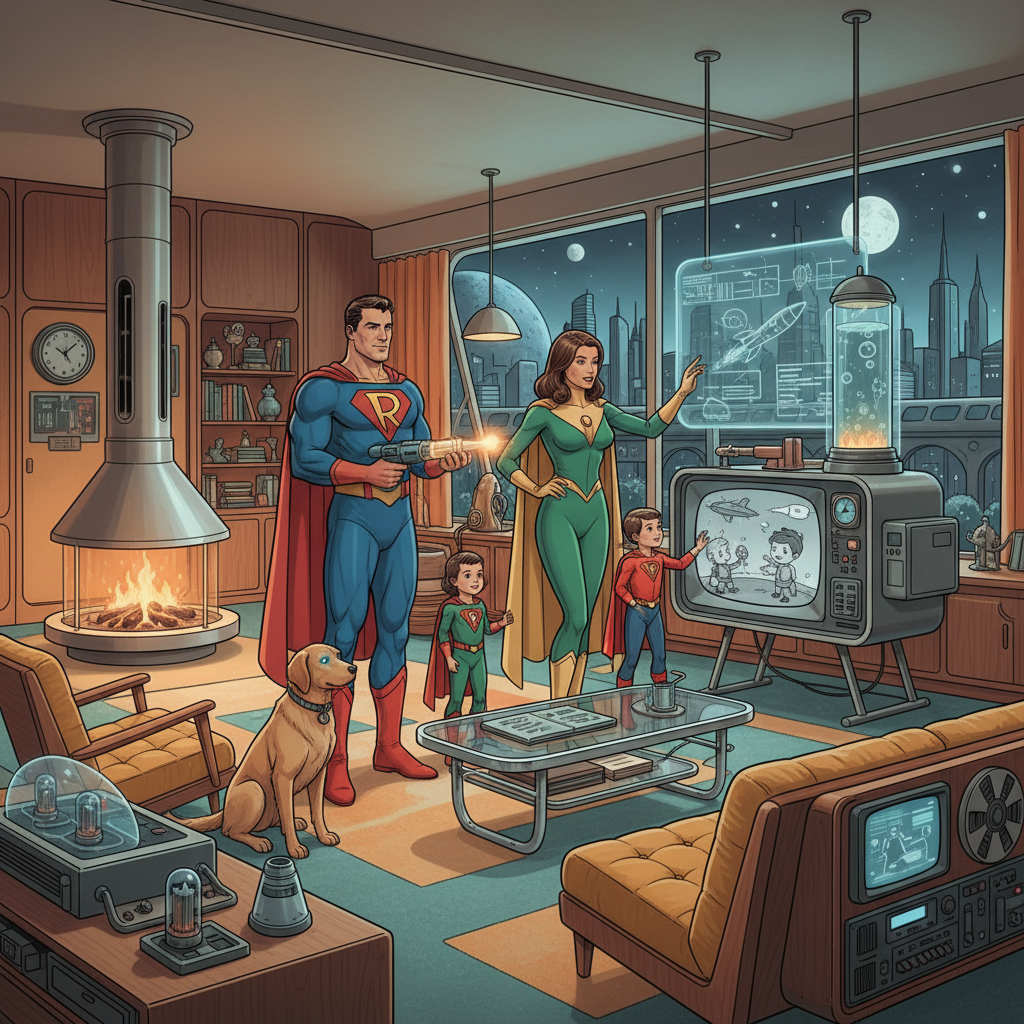
Early in the film, a talk show hosted by Mark Gatiss’s character (another kind of retro touch) fills us in on the origins of these specific versions of Marvel’s first family. Four years earlier, Richards, Storm, Storm, and Grimm took part in a space mission, were bombarded by radiation and went through genetic changes: Reed can stretch his limbs, Sue can become invisible and generate force fields, Johnny can light himself on fire and fly, and Ben Grimm turned into a large rock-skinned creature with great physical power. They all return to Earth, become heroes, and now live together in a mid-century modernist compound that looks like the production design of a SyFy movie from the late ’90s: floating cars, handwritten equations on chalkboards, a toddler-sized robot butler named H.E.R.B.I.E. attending to them in every domestic setting. You will not see a cell phone in this movie. But there are a lot of square television sets.
If there’s a flaw in the visual style, it’s a function of the design. First Steps looks like the Marvel Universe imagined by Tomorrowland, distilled through the perspectives of The Jetsons and Lost in Space. (One of Galactus’s heralds is voiced by Kirsten Dunst, whose likeness is used in motion capture. She’s part fashion model, part lounge singer.) And the story, for its part, has neither the gravity nor the velocity to escape its retro-futurist design.
Family is the throughline of the film, and specifically the solidarity and single-minded purpose of the four leads. Sue discovers early on that she is pregnant, and Reed is at once anxious and earnest when he hears. In one standout sequence, he has H.E.R.B.I.E. help him baby-proof not just their domestic space, but also his home base as a scientific research facility. Johnny and Ben snipe at each other like siblings more than partners; they provide comic relief and dimension to the other two’s central story, but the script makes clear that they are on board with being uncles. The arc of Reed and Sue’s relationship is roughly baby-focused even when they’re not on the job: as parents and guardians, they are learning to live and work with one another at a new stage in their family’s life.
As for the space-based external conflict, it never goes away. Galactus, the big armored guy with the glowing eyes, is on the way to Earth. He’s on a planet-swallowing mission: if there is life on the world he intends to arrive at, he intends to absorb it into himself. (Think of him as a baby-eating planet, on human scale.) So before he gets there, he dispatches a herald to warn the planet’s residents. A silver-skinned woman in an armored bodysuit (Julia Garner does the motion capture work), the Silver Surfer is sleek and stylized, but like most things in this world, she quickly gets to be the object of a crush (or at least a fixation) for Johnny.
The action sequences that follow are more low-stakes than the final scenes of Infinity War. Galactus must be diverted to another galaxy, which means a great deal of running around in zero gravity, dodging blasts from the Surfer, and not much actual superhero combat. The visual effects lean hard into the retrofuturism: flashes of light, blazes of fire, explosive squibs that never look quite real. Sue, heavily pregnant, starts going into labor at the literal height of the action. Childbirth in space has rarely felt so absurd. It’s a single-minded, if slightly misplaced, blend of sincerity and nonsense.
That is the tenor of the film’s execution. It wants to hit genuine emotional notes, but it often has difficulty rising above the pastel-colored mush in which it is so deeply steeped. The plot, with the destruction of the planet at its conceptual center, never feels as if there’s a lot at stake. There are perilous moments, sure. But the tone is more Goonies than Guardians of the Galaxy.
If the Marvel Cinematic Universe as a whole is best known for the stakes that it has set (Avengers: Endgame practically invented apocalyptic comic book storytelling) and its willingness to push up against the boundaries of those high stakes (if there are multiverses and branching timelines, everything is permitted! ), The Fantastic Four: First Steps will likely feel a bit more niche. It is kid-friendly and sweet and offers some great performances. But it’s hard to imagine First Steps blowing anyone away.