
- calendar_today August 18, 2025
Nvidia, a name synonymous with cutting-edge graphics technology, is now venturing into an intriguing new domain: Artificial intelligence now merges seamlessly with the gaming experience. Nvidia remains best known for its AI-accelerating GPUs that produce stunning visuals, yet its experimental G-Assist AI marks its newest venture.
Harmonizing Hardware: AI Control Over Gaming Ecosystem Peripherals
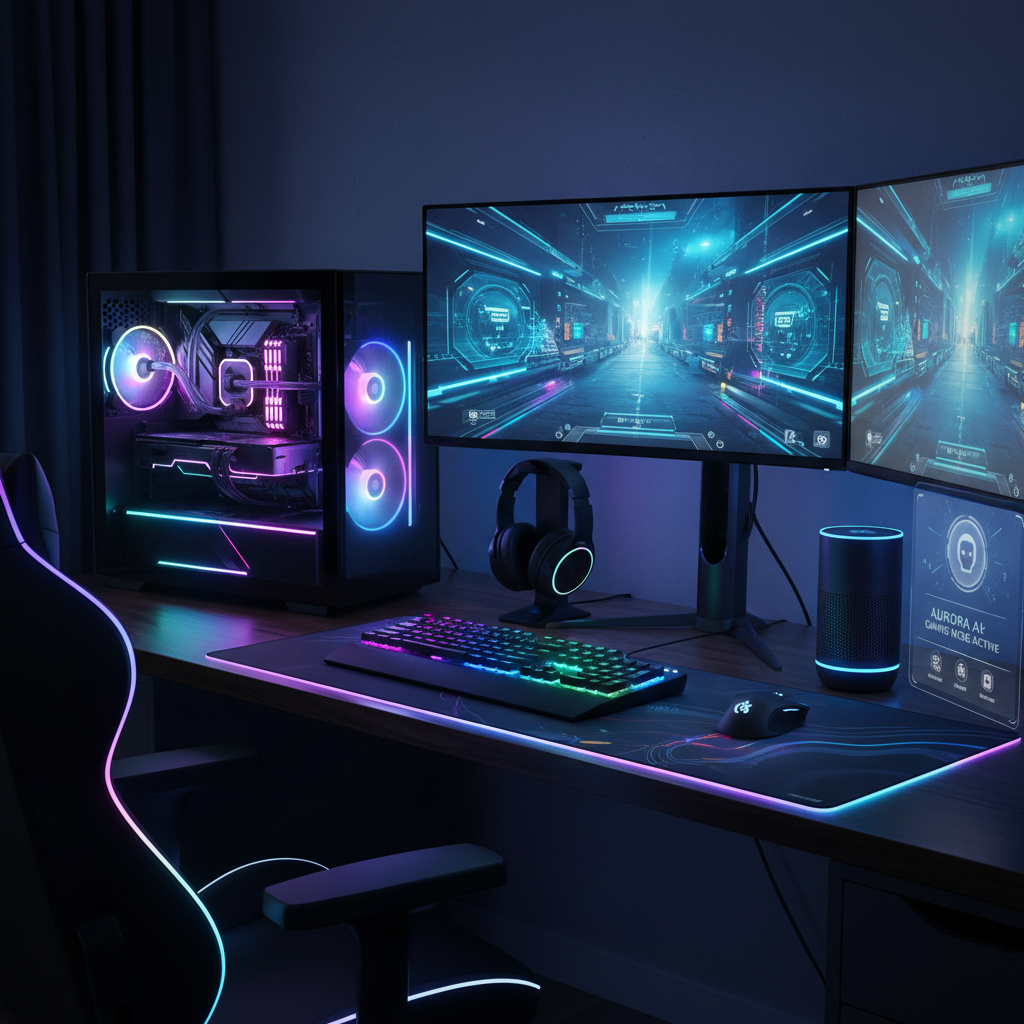
Through its strategic incorporation of powerful third-party plug-ins, Nvidia has extended the practical applications of G-Assist. G-Assist naturally supports direct communication with many gaming peripherals produced by major manufacturers, including Logitech G, Corsair, MSI, and Nanoleaf. The integration of G-Assist creates extensive opportunities for developing an integrated intelligent gaming ecosystem.
Picture programming MSI motherboards to modify cooling profiles according to each game’s real-time thermal requirements while directing Logitech G devices to automatically adjust their RGB lighting in response to game events to create an enhanced immersive and responsive gaming experience. The AI’s control over multiple hardware components marks an important advancement towards creating a unified and intelligent PC gaming system.
The emerging trend toward AI integration in personal computers and the popularity of “AI laptops” has led Nvidia to highlight desktop systems’ existing AI processing strengths through their high-performance GPUs. The ChatRTX application developed by Nvidia offers broader functionality than the cloud-dependent AI tools that dominate modern computing. G-Assist directs its efforts toward meeting the specific gaming community needs whose systems include powerful GPUs as essential gaming components.
Nvidia explains that G-Assist functions via a compact, highly optimized language model (SLM), which enables direct local execution on the user’s hardware. The software demands 3GB of storage space for its text installation, while the voice control feature extends this requirement to 6.5 GB. G-Assist requires a minimum of a GeForce RTX 30, 40, or 50 series GPU with at least 12GB dedicated video memory for operation.
G-Assist’s operational speed and efficiency increase proportionally with the host GPU’s processing capability since higher-end graphics cards deliver substantially quicker and smoother AI assistant performance. The team plans to enable laptop GPU support at a later stage, but existing mobile GPUs’ performance constraints may hinder G-Assist’s effectiveness in portable gaming environments.
Running G-Assist on the GPU locally provides future benefits like improved data privacy and faster response rates, but it introduces substantial immediate challenges. When interacting with the AI model during internal testing with a mid-range RTX 4070 graphics card, usage showed a measurable spike in GPU utilization. Generating responses from the language model imposes significant computational demands that directly affect the performance of other tasks that share computing resources with it, especially graphically demanding video games.
Testing of Baldur’s Gate 3 running at full visual settings under active G-Assist processing displayed about a 20% frame rate decline during demanding gameplay. Users with systems that are already operating at peak performance limits for demanding games may find their performance bottlenecks intensified by the introduction of G-Assist.
G-Assist shows increased speed and responsiveness when used outside graphically demanding applications, yet demands a high-end GPU for consistent use to prevent noticeable performance drops during gameplay.
The experimental status of G-Assist manifests through its intermittent slow response times and various software bugs. Most players find that manually configuring system and game settings continues to deliver better reliability and quicker optimization than other methods.
G-Assist serves as an innovative beginning for unlocking existing AI processing power in gaming PCs, but still offers a forward-looking approach. The relentless and fast-paced development of GPU technology makes it possible to run both complex video games and advanced AI models at the same time without interruption.
Right now, Nvidia’s G-Assist presents an interesting glimpse into a future where artificial intelligence enhances gaming experiences while your GPU not only creates stunning virtual environments but also works alongside you to manage your entire gaming system.