
- calendar_today August 17, 2025
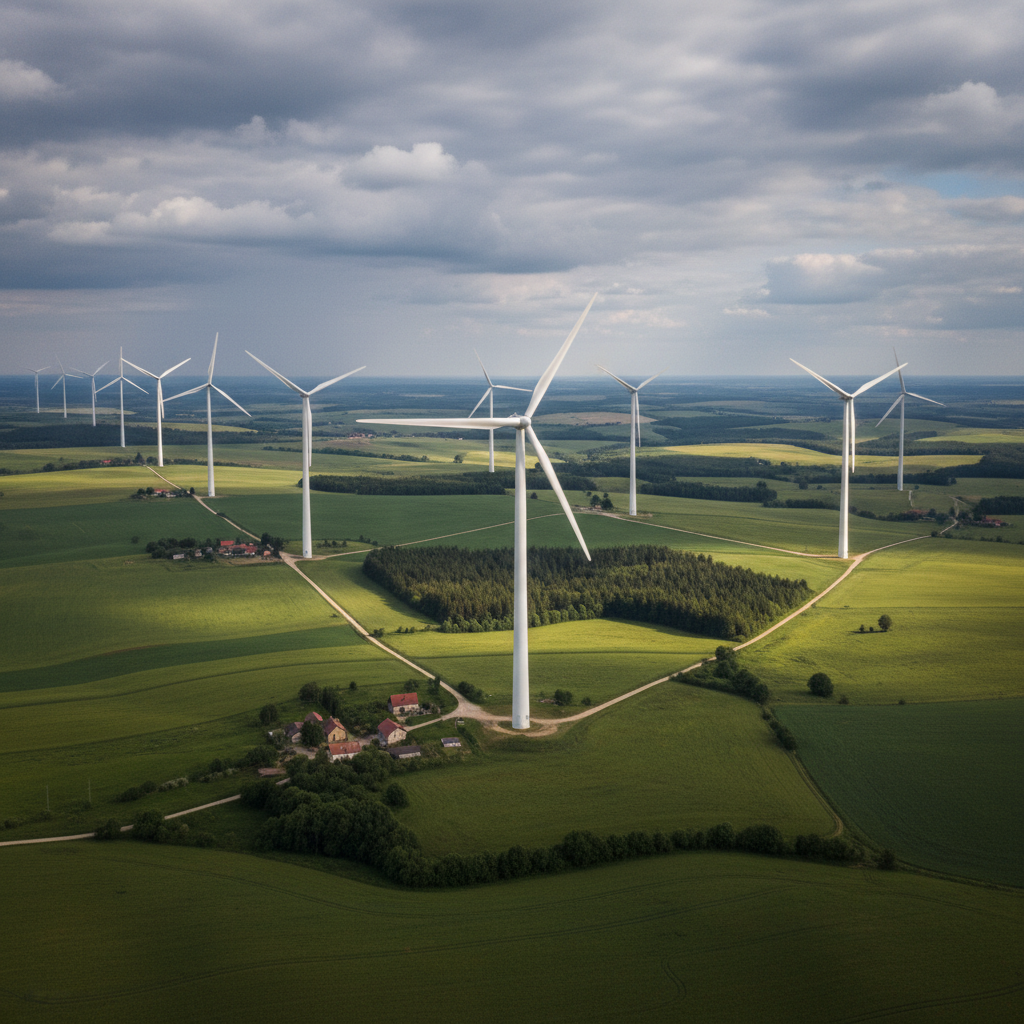
The setting was supposed to be a press conference on a European Union trade deal. But former U.S. President Donald Trump could not resist a foray into his familiar terrain of mocking renewable energy. Wind turbines, he declared, are a “con job” that drives whales “loco,” kills birds, and can even kill people.
Trump’s comments were true to form, combining his signature bombast with a lack of fidelity to the facts. If wind turbines are a “con job,” the clean energy revolution must be one of the biggest scams in human history. And while Trump’s jokes about renewables typically earn more attention for their outrageousness than their accuracy, they also reflect a wider pattern of conspiracy theories around wind power—and renewables more generally—that spans the globe.
The fossil fuel-funded “war on science”
Many of Trump’s claims have been on the public record for some time. He has repeatedly and incorrectly referred to turbines as “windmills” in official government documents and on social media. “Windmills” has since become a kind of in-joke shorthand among climate deniers, and one of Trump’s most recent tweets repeats much of the verbiage from previous comments by his administration.
Wind energy has also been the subject of moral panics before. In the 19th century, many people opposed the widespread use of telephones on the spurious grounds that they would spread disease. Similar conspiracy theories today suggest 5G cell towers cause COVID-19. The fear is about change, about losing our way of life, about new powers rising to supersede old ones.
But research shows those fears go deeper than ignorance. Once conspiracy thinking finds a home in a person’s worldview, it is not easily dislodged by a fact check or a doctor’s note. The problem for governments, businesses, and other institutions is that this kind of skepticism and cynicism threatens the entire process of energy transition. It is one of the major factors slowing the widespread deployment of clean energy.
Origins of anti-wind conspiracy theories
Climate science has been warning since at least the 1950s that increasing carbon dioxide emissions would cause major, relatively near-term changes to the environment. The early stages of the renewables push, however, were mostly focused on taking power away from fossil fuel companies. A famous example of this trope is from The Simpsons, when the greedy tycoon Mr. Burns erects a tower to block out the sun in order to force the people of Springfield to buy his nuclear power instead. The cartoon is an obvious exaggeration, but it taps into a fear that exists in the real world—that fossil fuel lobbyists and wealthy executives will hold back renewables adoption to protect their interests.
In fact, history has shown those concerns to be entirely well-founded. In 2004, then–Australian Prime Minister John Howard created a coalition of fossil fuel executives called the Low Emissions Technology Advisory Group. Ostensibly to help Australia’s clean energy future, the group actually worked to slow the growth of renewables and hold the line for coal, oil, and gas.
Wind farms have also faced public resistance. Unlike coal mines and oil fields or nuclear power plants—which are often located far away or underground—wind turbines are large and visible. These “intrusive” structures were often built on ridgelines or plains, and have long been easy targets for naysayers and conspiracy theorists.
Medical experts have called the supposed “wind turbine syndrome” a “non-disease.” Despite being contested by science for years, the false syndrome was later conflated with other conspiracy theories.
Studies have shown that factors such as age, gender, education, or political affiliation only explained a small amount of opposition to wind farms. Instead, people who believed in one type of conspiracy theory (such as denial of climate change, government control, or threats to energy security) tended to support other conspiracy theories, including ones about the impact of wind farms.
For these people, facts are no counter. They will not be persuaded that wind farms don’t poison water, cause blackouts, or kill people, because their opposition to wind farms is part of a larger worldview, not a mistaken belief that can be rectified with facts. “Opposition to wind farm development is thus rooted in people’s worldviews,” the researchers concluded.
Wind farms have become a lightning rod for both pro- and anti-clean energy sentiments. To supporters, they represent a cleaner and more innovative future. To opponents, they represent government control, a loss of agency, and unwanted change.
Underpinning this debate, however, is a cultural conflict. Fossil fuels enabled a certain way of life, and for some people, admitting fossil fuels have real environmental downsides is like an admission of collective wrongdoing. As several academics have written, this is a kind of “anti-reflexivity.” Trump and other leaders who often hark back to the days of coal, oil, and gas fit neatly into that frame.
Opposition to renewables also has elements of identity politics. In some corners of the internet, such as certain parts of the “manosphere,” worries about climate change or renewable energy are often rejected as unmanly or weak. For some men, particularly white heterosexual baby boomers, the transition to clean energy is part of a wider shift in a world where they no longer feel so powerful. It’s not just about technology: it’s also about culture and identity.
And for Trump’s supporters, his barbs about “windmills” speak to those fears and concerns. It doesn’t matter if wind turbines cause madness in whales or kill innocent birds. The point is that they can be portrayed as an existential threat to a way of life. Trump’s colorful attacks are a convenient amplifier, his crazy claims about birds and electromagnetic fields an attention-getting tactic. But beneath the rhetoric and the trolling, his comments and policies tap into a deeper anxiety and a larger story. Opposition to renewables is rarely about renewables. It is about power. It is about identity. And it is about the difficult process of reckoning with a changing world.